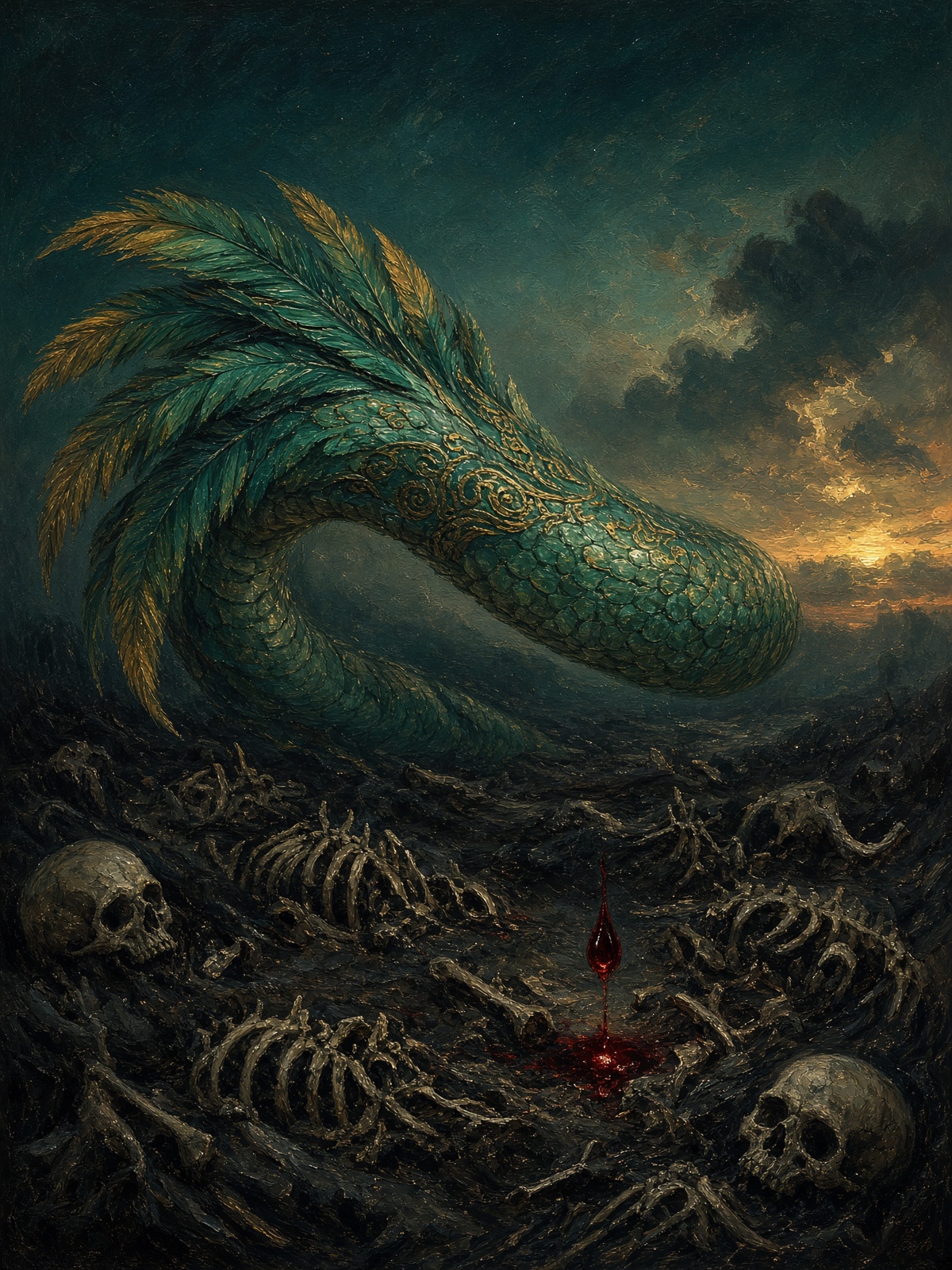
“I brought the bones.”
The underworld keeps what it is owed.
Quetzalcōātl is wind, dawn, priest-king of a golden Tollan in the stories. He refuses human sacrifice in some tellings; his rival Tezcatlipoca tricks him into drunkenness and a broken vow. He leaves, burning or sailing east, promising a kind of return. He is also the one who descends to bone-land to retrieve the ingredients of a new humanity, bleeding on the bones to quicken them.
A living set of cultures still holds these figures. Here they are offered as public, widely told patterns: a civilizing gift, a shame, an eastward departure, a possible dawn.
Inspect
INTERPRETATION
Quetzalcōātl is the high ideal that cannot survive a single night of being merely human: unless it learns to. Shame that ends a vocation is the shadow of purity. The descent for bones is the better myth: new people are made from what was buried, plus a drop of your own blood.
The shadow
Purity that ends a vocation. Shame that sends the gift east.
Four lookings
Campbell
If you sailed east, what dawn would you actually be seeking?
von Franz
Where has purity become the enemy of your continuing?
Hillman
What bones are you being asked to retrieve from the underworld of your own past?
Coelho
What gift went into exile because you could not bear a stain on the ordinary day?