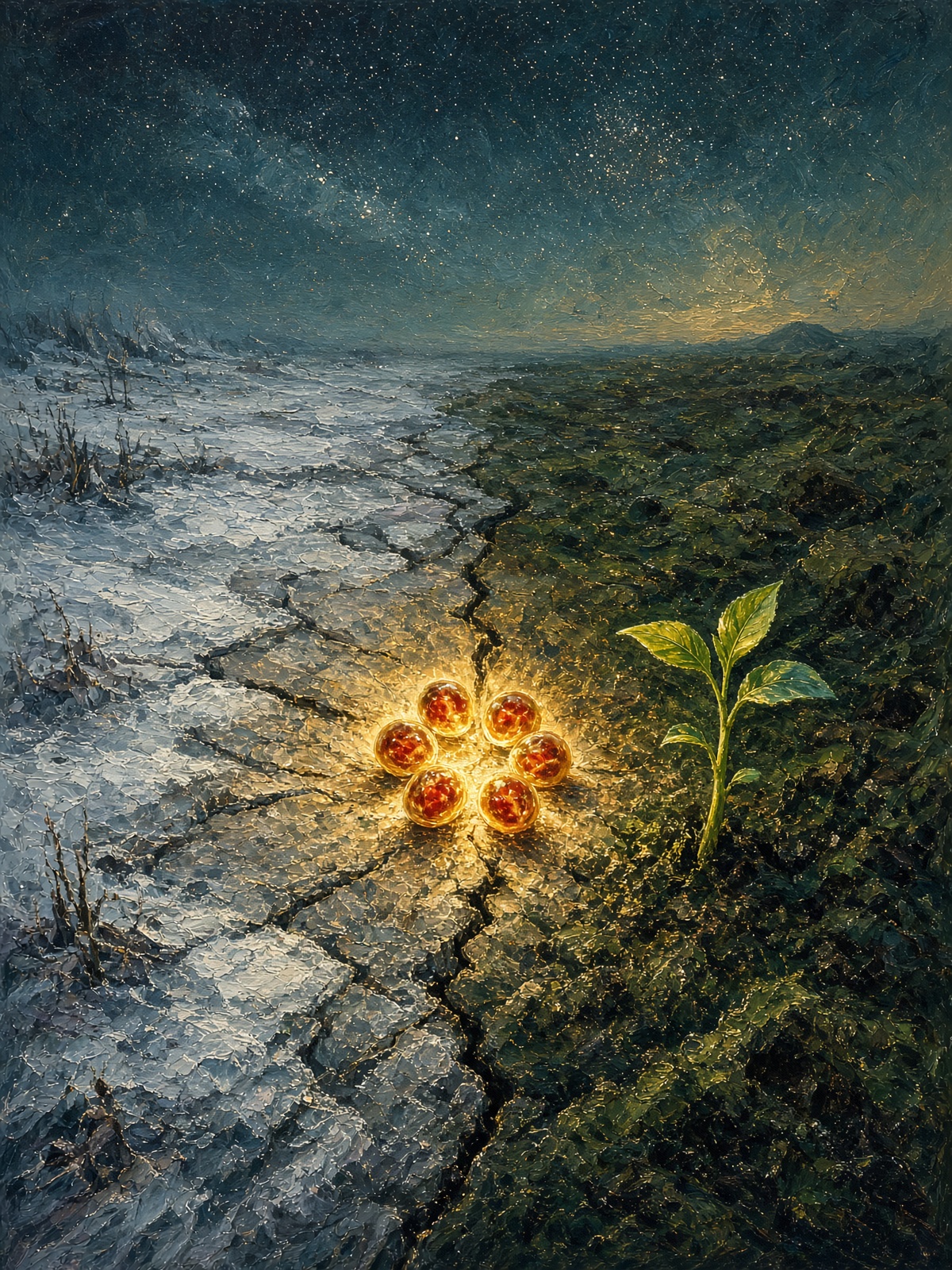
“She had eaten the seeds.”
A pomegranate. What you take in the dark stays.
Kore is gathering flowers when the ground opens. Hades takes her below. Demeter, refusing to let the world go on as if nothing happened, starves the fields until a bargain is struck. Persephone will rise, but she has eaten the pomegranate. The seeds are not a trick so much as a fact: what you take in the dark becomes part of you. She does not come back as the girl who left. She comes back as someone who can walk both worlds, and the seasons learn to breathe around that split.
The Eleusinian rites treated this not as a kidnapping anecdote but as the secret of grain: life is cyclic, and the underworld is not the opposite of life. It is the cellar where life is stored.
Inspect
INTERPRETATION
When Persephone arrives, a life is often in a necessary winter. Not punishment: initiation. The work is not to claw back to an earlier self, but to notice what you ingested while you were down there, and what you are now queen of.
The shadow
Not the kidnap. The winter she becomes queen of, and the girl who still wants to be only spring.
Four lookings
Campbell
Where is return possible, and where would return be a lie?
von Franz
What season of yourself are you refusing to name as a season?
Hillman
What did you eat in the dark that is trying to feed you now, not to be spit out?
Coelho
If the underworld left one omen in your ordinary day, what would it be?