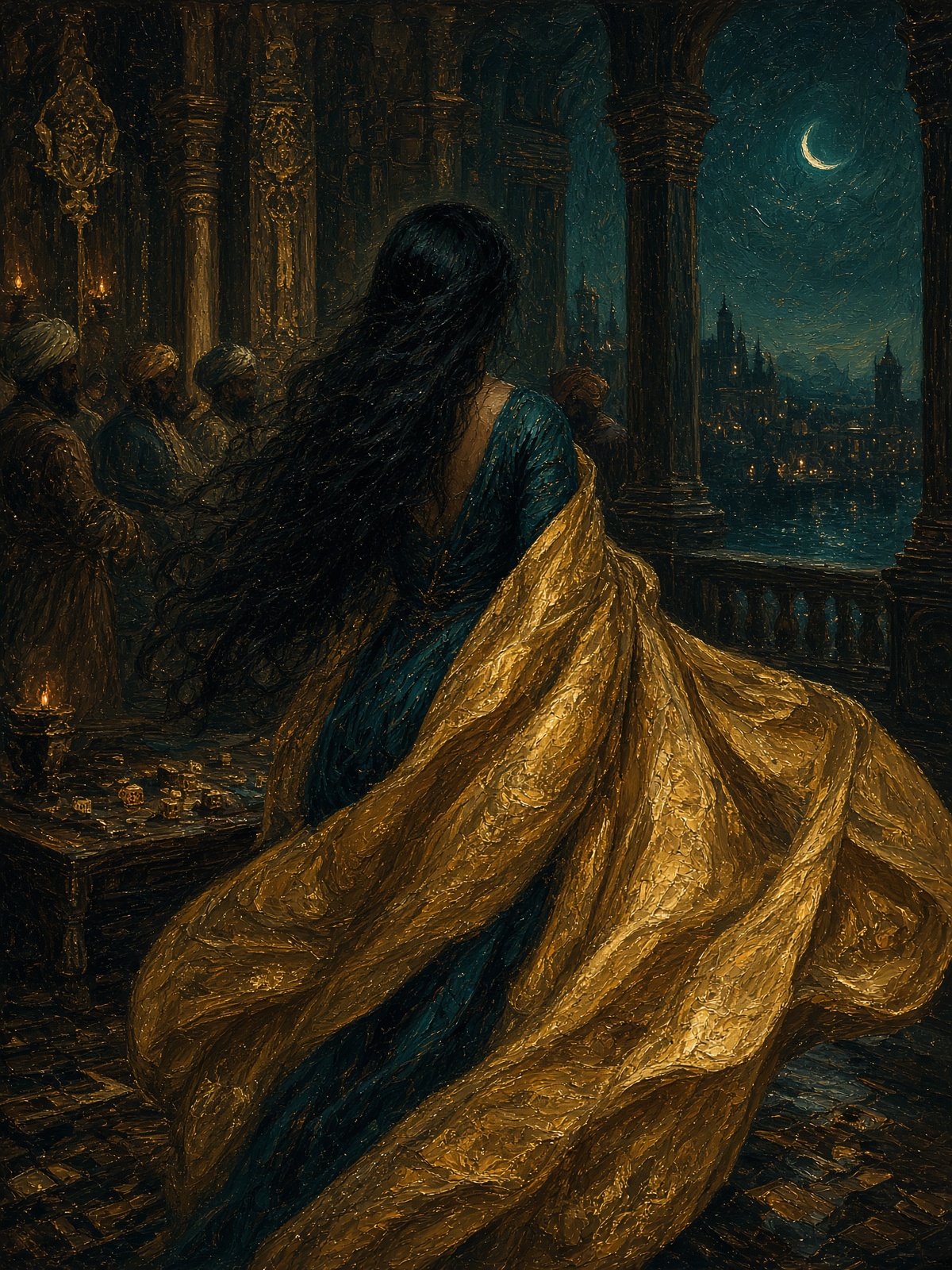
“I was gambled.”
Four dice. The sabha is waiting.
Draupadī, born from a fire, is wife to the five Pāṇḍavas. In the dice hall she is staked and lost. Duhśāsana tries to strip her; the cloth keeps coming. She asks the assembly a legal and cosmic question: could she be wagered if she was not already owned? The men of the court fail the question. She refuses to braid her hair until the account is settled.
She is one of the epic’s clearest minds. Wrath, in her, is not hysteria. It is memory with a spine.
Inspect
INTERPRETATION
Draupadī arrives when a humiliation has been public and the surrounding system has watched. The unbraided hair is a refusal to return to cosmetic peace. Healing that skips justice will not hold.
The shadow
Cosmetic peace after the hall. Hair braided back as if the question had been answered.
Four lookings
Campbell
Where are you being treated as stakes in someone else’s game?
von Franz
Which of your angers is actually a legal question no one in the room would answer?
Hillman
What would it mean to keep a vow of memory without becoming only the vow?
Coelho
What have you braided back too soon, as if the hall had already answered?
Enter the plot
The hall, with no cosmetic peace
A short night: dice, the hall, unbraided hair. The long night adds fire-birth and the cloth. Dignity here is not politeness.